KZN motorists are urged to exercise caution on the province's roads due to the extremely wet weather conditions.
Metro police's Eugene Msomi says they have received several reports of roads that are flooded in and around Durban.
"We have flooding on the southern freeway by Quality Street. The other one is on South Coast Road, by Blamey Road. We urge everyone just to be careful."
Only one lane is open on the M4 Southern freeway, southbound, at Quality Street, creating a traffic backlog.
There are also problems on the freeway's northbound carriageway near the old airport site. A deep puddle of water is causing chaos for motorists travelling just past the Isipingo off-ramp.
Motorists on the N2 in the Groutville area are also experiencing slippery conditions with wet patches on some parts of the road between Tongaat and FairBreeze.
In the Durban CBD, there have been reports of vehicles getting stuck on Canongate Road and Warwick Avenue heading towards the city.
- East Coast Radio News
Showing posts with label floods. Show all posts
Showing posts with label floods. Show all posts
Tuesday, 26 March 2013

Saturday, 16 February 2013
Peru: Floods and Landslides - Feb 2013
Torrential rains starting on 8 Feb 2013 caused flooding and landslides in the Arequipa province of southern Peru. Five people were killed, 75 injured and 48,000 affected. 15 houses were destroyed and 4,000 damaged. The government declared a state of emergency.
So far, almost 80,000 people have been affected by heavy rains and flooding across the country since October 2012; 31 people have been killed, over 3,200 injured. Over 700 houses were destroyed and more than 11,000 were damaged. Two schools were destroyed and 19 schools and 10 health facilities were damaged.
- ReliefWeb
So far, almost 80,000 people have been affected by heavy rains and flooding across the country since October 2012; 31 people have been killed, over 3,200 injured. Over 700 houses were destroyed and more than 11,000 were damaged. Two schools were destroyed and 19 schools and 10 health facilities were damaged.
- ReliefWeb
Wednesday, 13 February 2013
Search underway for flood victims in Kwazulu Natal
Disaster management teams are still searching for four people thought to have been swept away by flooded rivers in the Msinga area, near Greytown in KZN.
Co-operative Governance says the bodies of two other people have already been recovered.
The area was lashed by Monday night's severe storm and dozens of homes were damaged after the iSibumba river burst its banks.
The department's Lennox Mabaso says KZN's premier will visit the area today to assess how to assist those who have been affected.
Mabaso says there is a sombre mood in Msinga, especially now that the extent of the damage is being properly gauged.
"Some houses that were washed away, we're not talking just small houses, we're talking about huge houses - those people would have invested a lot of money in constructing them. Some had eight rooms, some six rooms," he said.
"With the news trickling in of bodies being recovered - it changes the picture because the families have been living in the hope of finding their loved ones still alive."
Mabaso says officials are busy building temporary shelters and supplying food to the affected communities.
- East Coast Radio News
Co-operative Governance says the bodies of two other people have already been recovered.
The area was lashed by Monday night's severe storm and dozens of homes were damaged after the iSibumba river burst its banks.
The department's Lennox Mabaso says KZN's premier will visit the area today to assess how to assist those who have been affected.
Mabaso says there is a sombre mood in Msinga, especially now that the extent of the damage is being properly gauged.
"Some houses that were washed away, we're not talking just small houses, we're talking about huge houses - those people would have invested a lot of money in constructing them. Some had eight rooms, some six rooms," he said.
"With the news trickling in of bodies being recovered - it changes the picture because the families have been living in the hope of finding their loved ones still alive."
Mabaso says officials are busy building temporary shelters and supplying food to the affected communities.
- East Coast Radio News
Limpopo flood damage put at R300m

Limpopo flooding (Elana Treu-Viljoen, Supplied)
Johannesburg - Limpopo's January floods caused damage estimated at over R300m, the transport department said on Tuesday.
"The estimated damage to the roads and bridges according to the preliminary inspection is R317m," spokesperson Tiyani Rikhotso said.
Minister Ben Martins visited the province on Monday and Tuesday to inspect the areas damaged by the floods.
"Many communities have been affected," Martins said in a statement.
"The destruction of roads and bridges has exacerbated the infrastructure backlog, considering that many communities still do not have access to adequate transport infrastructure and services."
According to preliminary reports, 61 bridges and roads were damaged in the Vhembe district, 24 roads and bridges were damaged in Mopani, 12 roads and bridges were damaged on Sekhukhune, and five in the Waterberg, he said.
The affected communities were looking to the government to address their plight, but it could attend to their needs only if public servants were willing, Martins said.
He said the transport department intervention team had made significant progress stabilising the provincial department and its agencies.
The team had introduced various measures to improve governance, financial accountability and service delivery.
Where there was "prima facie evidence of transgressing the law", it had referred cases to law enforcement.
Martins said disciplinary action was being taken against people who undermined policies and government procedures in the province.
Various vacancies would also be filled.
"Whatever we do should be informed by due processes," he said.
"Notwithstanding the work of the democratic government since 1994, a lot still needs to be done to address the skewed distribution of resources within and between communities."
He said it was important that the effort to stabilise the province was sustained even after the intervention team had left.
- SAPA/News24
Thursday, 7 February 2013
Botswana: Floods - Jan 2013

Flooding due to extremely heavy rains in the North-East and Central districts of Botswana has affected 842 households, including 32 households in Dukwi refugee camp, since mid-January 2013. The number of affected people is expected to rise as village reports are received and assessments completed. While the immediate shelter needs of virtually all affected people have been met, this response has almost completely exhausted existing supplies, limiting the capacity to respond to future hydro-meteorological disasters. (UN RC, 1 Feb 2013)
- Relief Web
Wednesday, 6 February 2013
Mozambique: Flooding - Office of the Resident Coordinator, Situation Report No. 3 (as of 4th February 2013)


Highlights
- Coordination activities have been reinforced by the Government with the set-up of a mobile emergency operations center in Xai-Xai, capital of Gaza Province.
- Response in Gaza Province is ongoing. Air drop and air bridges are ensuring provision of humanitarian assistance to people stranded in isolated districts.
- Health and sanitation concerns are emerging in flood-affected districts where water levels are receding, where proper cleaning up and restoration of basic health service are priority.
- In Zambezia and Nampula Provinces (Central and North regions), 15 people died due to heavy rains, which have affected about 60,000 people and caused total or partial damage about of about 6,000 houses.
- Funding requirements for humanitarian and recovery needs in the next 6 months have been estimated at USD 30.6 million in Gaza Province.
Full report available HERE
SA farmers helping ease Mozambique food crisis

Cattle being guided away from the Limpopo River, which burst its banks in southern Mozambique about two weeks ago leading to severe flooding. Most of the farmland in the region was devastated by the floods, sparking fears of a food crisis Picture: KEVIN SUTHERLAND
South African farmers are coming to the aid of their Mozambican counterparts, whose lands were devastated in the flooding that killed more than 80 people and put the lives of thousands at risk.
Many farms in southern Mozambique are under water. Equipment, crops and seed have been destroyed and thousands of animals drowned.
The cost of the flooding has yet to be determined.
"It is millions and millions of dollars," said Gaza provincial agriculture director Ernesto Paulino.
"But this is not the worst. The exact toll will only be known when harvest time comes. Only then will we know how bad it is and how bad it's going to get."
Xai Xai and Chokwe, towns in Gaza, were at the heart of the flooding.
Paulino, who has organised farmers into groups to try to salvage the little equipment, seeds and crops they have, said the destruction of 90000ha of farmland around Xai Xai would affect the food security of more than 400000 people.
More than 76000 families were facing immediate food shortages.
"This is a serious problem ... We have lost everything - from maize fields to vegetable fields," he said.
Millions of rands worth of seed and maize have been pledged to the Mozambicans by farmers in the Free State and North West. The first truckload is expected to arrive in the country today.
The founder of South African humanitarian aid agency Gift of the Givers, Imtiaz Sooliman, said the first consignment of seed and maize, valued at R20-million, was on its way to Mozambique.
"Not only businesses have opened their hearts, but so too have our farmers. Since the call went out, our phones have not stopped ringing," he said.
Paulino said the help was a blessing.
"Every little bit that comes is greatly appreciated," he said.
- Times Live
Tuesday, 5 February 2013
Preparedness pays as hundreds of thousands flee from floods in Mozambique
Yvonne is 64. She has spent the last six days on a roof. The rest of her family fled the village ten days ago after packing everything they could onto a small cart, but Yvonne stayed, hoping the oncoming floods would recede quickly so she could salvage and protect her house and her things. But the water flowed in and rose up fast. So she climbed onto the roof and waited.
When she felt the water was shallow enough, she climbed down and walked 25km to an agreed meeting point. As she arrives, the family gather round, cheering and clapping. Yvonne does a little dance and joins the six children and three adults huddled under a plastic sheet.
Scattered around her and stretching along miles of road are tens of thousands of other families, huddled under dense trees for shelter. A few have tents, some have plastic sheets, but most are out in the open. The majority are women and children. They are cooking, breastfeeding, fanning themselves, sleeping and braiding their children's hair. They have all managed to salvage something from their homes so they sit around piles of cases and bags.
That they have been able to save anything is testament to the one piece of good news in a crisis that has displaced 200,000 people. The early warning systems worked.
Improved climate science, combined with the commitment of the authorities to disseminate warnings through radio and volunteers with the Mozambique Red Cross Society, meant people had time to pack and leave for higher ground. During the floods of 2000, over 700 people died. So far in 2013, fewer than 100 have lost their lives.
Yet while the early warning is impressive, the overall response is less so. In this one district of Gaza, 100,000 people are sleeping in the open, and there are also problems with food, water and hygiene. Relief is being distributed, but it is in painfully short supply. Roads are still crammed with moving people, and the numbers are swelling.
Spirits, though, remain high. These families have lost precious reserves of food; their houses and many of their belongings are gone; yet the women still make sure their clothes and children are clean. For now there is still laughter and conversation.
Conditions will get worse. Constant rains seep through the leaves and chill those huddled beneath. At night there is no protection from mosquitoes. The stench from the bushes, which are being used as latrines, is stronger each day.
"I am tired and want to leave," says 25-year-old Anisia. "We wanted to go back today but we've been warned that more rain is coming. Last time, people went back too early and got trapped. So for now we have to stay."
Along the roadsides, women dry the soaked maize and rice that they have pulled from beneath the water. In front of a flooded food store, crowds of women comb through filthy, black pools to find drenched bags of maize. Guards chase them away with sticks. The women tumble and splash away, roaring with laughter and dripping wet, but clinging to their prizes. This produce is rotten, selling it and eating it will cause a major health hazard over the coming days.
The temptation to return is strong. When the waters recede, the soil will be fertile and the women want to get back and plant. Their houses will be buried in mud, the smell of dead animals and the buzzing of insects will be hideous, but at least they will be growing, not using, the little that they have.
There will be lessons. Should people have been more prepared? There are parts of the region, for example along the Okavango Delta in Botswana, where communities have learned to live with flooding. They build their houses on high foundations or on stilts, and villages maintain boats for movement and evacuation. But it has been over ten years since these communities in Mozambique have faced floods like this. How much will they will be willing to invest in infrastructure to protect against a rare occurrence?
For now though, the immediate challenge is relief. 200,000 people will need a lot of water, food, sanitation and shelter to stay healthy out in the open before they can return home safely and face the struggle of rebuilding their lives.
- ReliefWeb
When she felt the water was shallow enough, she climbed down and walked 25km to an agreed meeting point. As she arrives, the family gather round, cheering and clapping. Yvonne does a little dance and joins the six children and three adults huddled under a plastic sheet.
Scattered around her and stretching along miles of road are tens of thousands of other families, huddled under dense trees for shelter. A few have tents, some have plastic sheets, but most are out in the open. The majority are women and children. They are cooking, breastfeeding, fanning themselves, sleeping and braiding their children's hair. They have all managed to salvage something from their homes so they sit around piles of cases and bags.
That they have been able to save anything is testament to the one piece of good news in a crisis that has displaced 200,000 people. The early warning systems worked.
Improved climate science, combined with the commitment of the authorities to disseminate warnings through radio and volunteers with the Mozambique Red Cross Society, meant people had time to pack and leave for higher ground. During the floods of 2000, over 700 people died. So far in 2013, fewer than 100 have lost their lives.
Yet while the early warning is impressive, the overall response is less so. In this one district of Gaza, 100,000 people are sleeping in the open, and there are also problems with food, water and hygiene. Relief is being distributed, but it is in painfully short supply. Roads are still crammed with moving people, and the numbers are swelling.
Spirits, though, remain high. These families have lost precious reserves of food; their houses and many of their belongings are gone; yet the women still make sure their clothes and children are clean. For now there is still laughter and conversation.
Conditions will get worse. Constant rains seep through the leaves and chill those huddled beneath. At night there is no protection from mosquitoes. The stench from the bushes, which are being used as latrines, is stronger each day.
"I am tired and want to leave," says 25-year-old Anisia. "We wanted to go back today but we've been warned that more rain is coming. Last time, people went back too early and got trapped. So for now we have to stay."
Along the roadsides, women dry the soaked maize and rice that they have pulled from beneath the water. In front of a flooded food store, crowds of women comb through filthy, black pools to find drenched bags of maize. Guards chase them away with sticks. The women tumble and splash away, roaring with laughter and dripping wet, but clinging to their prizes. This produce is rotten, selling it and eating it will cause a major health hazard over the coming days.
The temptation to return is strong. When the waters recede, the soil will be fertile and the women want to get back and plant. Their houses will be buried in mud, the smell of dead animals and the buzzing of insects will be hideous, but at least they will be growing, not using, the little that they have.
There will be lessons. Should people have been more prepared? There are parts of the region, for example along the Okavango Delta in Botswana, where communities have learned to live with flooding. They build their houses on high foundations or on stilts, and villages maintain boats for movement and evacuation. But it has been over ten years since these communities in Mozambique have faced floods like this. How much will they will be willing to invest in infrastructure to protect against a rare occurrence?
For now though, the immediate challenge is relief. 200,000 people will need a lot of water, food, sanitation and shelter to stay healthy out in the open before they can return home safely and face the struggle of rebuilding their lives.
- ReliefWeb
UNICEF scales up support to Malawi’s Flood Victims as rains persist
Floods displace over 33 000 people and destroy schools
LILONGWE, 01 February 2013- UNICEF is scaling up its emergency assistance in Malawi after flooding has hit the country’s southern region. A recent inter-agency assessment estimated that over 33,000 people have been displaced leaving many people without shelter or clothing. Crops have been destroyed in Mangochi, Phalombe and Nsanje districts, while over 20 schools have been disrupted, affecting thousands of children.
“Communities, government, NGOs and the UN are working together to avert a humanitarian disaster,” said Mr. Mahimbo Mdoe, UNICEF Country Representative in Malawi. “But the rains are persistent and we remain on high alert as the flooding spreads to other areas.”
The persistent rains have destroyed roads making access to flooded areas difficult for the delivery of relief materials. Food, emergency shelter, medical supplies and other non-food household items such as blankets, buckets and pots are urgently needed for the affected amilies. The flooding has also compromised access to safe water, sanitation and overall hygiene in the affected communities.
In response, UNICEF is providing communities with a combination of water, sanitation and hygiene-related supplies. Supplies include chlorine, soap, water purification chemicals, plastic sheeting for construction of temporary bathing and latrine shelters, as well as hygiene awareness campaigns to prevent the risk of cholera.
Many displaced families have sought shelter in schools using them as kitchens and bedrooms resulting in considerable damage to school furniture and disruption in learning in at least 20 locations. UNICEF has provided the school-in-a-box supplies to ensure that quality learning resumes in the affected primary schools.
“Vital supplies are getting through to stricken communities,” said Mr. Mdoe. “But as UNICEF we remain vigilant, monitoring childhood diseases, ensuring schools are functional and that children go back to learning.”
Despite the flooding, Mangochi, Phalombe, and Nsanje are also among the districts hit hardest by the current drought, which has left nearly 2 million people food insecure and children at a high risk of malnutrition and disease across the country.
- UNICEF
LILONGWE, 01 February 2013- UNICEF is scaling up its emergency assistance in Malawi after flooding has hit the country’s southern region. A recent inter-agency assessment estimated that over 33,000 people have been displaced leaving many people without shelter or clothing. Crops have been destroyed in Mangochi, Phalombe and Nsanje districts, while over 20 schools have been disrupted, affecting thousands of children.
“Communities, government, NGOs and the UN are working together to avert a humanitarian disaster,” said Mr. Mahimbo Mdoe, UNICEF Country Representative in Malawi. “But the rains are persistent and we remain on high alert as the flooding spreads to other areas.”
The persistent rains have destroyed roads making access to flooded areas difficult for the delivery of relief materials. Food, emergency shelter, medical supplies and other non-food household items such as blankets, buckets and pots are urgently needed for the affected amilies. The flooding has also compromised access to safe water, sanitation and overall hygiene in the affected communities.
In response, UNICEF is providing communities with a combination of water, sanitation and hygiene-related supplies. Supplies include chlorine, soap, water purification chemicals, plastic sheeting for construction of temporary bathing and latrine shelters, as well as hygiene awareness campaigns to prevent the risk of cholera.
Many displaced families have sought shelter in schools using them as kitchens and bedrooms resulting in considerable damage to school furniture and disruption in learning in at least 20 locations. UNICEF has provided the school-in-a-box supplies to ensure that quality learning resumes in the affected primary schools.
“Vital supplies are getting through to stricken communities,” said Mr. Mdoe. “But as UNICEF we remain vigilant, monitoring childhood diseases, ensuring schools are functional and that children go back to learning.”
Despite the flooding, Mangochi, Phalombe, and Nsanje are also among the districts hit hardest by the current drought, which has left nearly 2 million people food insecure and children at a high risk of malnutrition and disease across the country.
- UNICEF
Flooding in Southern Africa

(Click on image for larger view.)
download large image (4 MB, JPEG, 3382x5073)
After days of torrential rain pushed the lower Limpopo River over its banks in late January 2013, flood water surrounded the city of Xai-Xai in southern Mozambique. The Advanced Land Imager (ALI) on NASA’s Earth Observing-1 (EO-1) satellite captured this natural-color image on January 31.
Xai-Xai is situated about 10 kilometers (6 miles) from the ocean, where the Limpopo River meanders over a flat coastal plain. In late January, muddy water not only filled the river channel, but also washed over agricultural fields. Muddy water could even been seen in the rectangular street grid of Xai-Xai.
The United Nations Institute for Training and Research (UNITAR) anticipated the flooding. On January 29, the institute reported that flood water had reached the northern edges of Xai-Xai; that the airport was inundated; and long stretches of roads had been flooded. UNITAR reported that the high water on the Limpopo—which had already inundated Chókwé—would continue to drain southward.
Flood waters were not confined to the lower Limpopo River. According to Voice of America and other news sources, flooding also struck the Zambezi River in northern Mozambique, as well as parts of Zimbabwe, Botswana, and South Africa. On February 2, Agence France-Presse reported that the death toll in Mozambique had reached 68, and the estimated number of people affected ranged from 180,000 to 250,000. News sources compared the current flood levels to those seen in the year 2000, when severe flooding claimed several hundred lives.
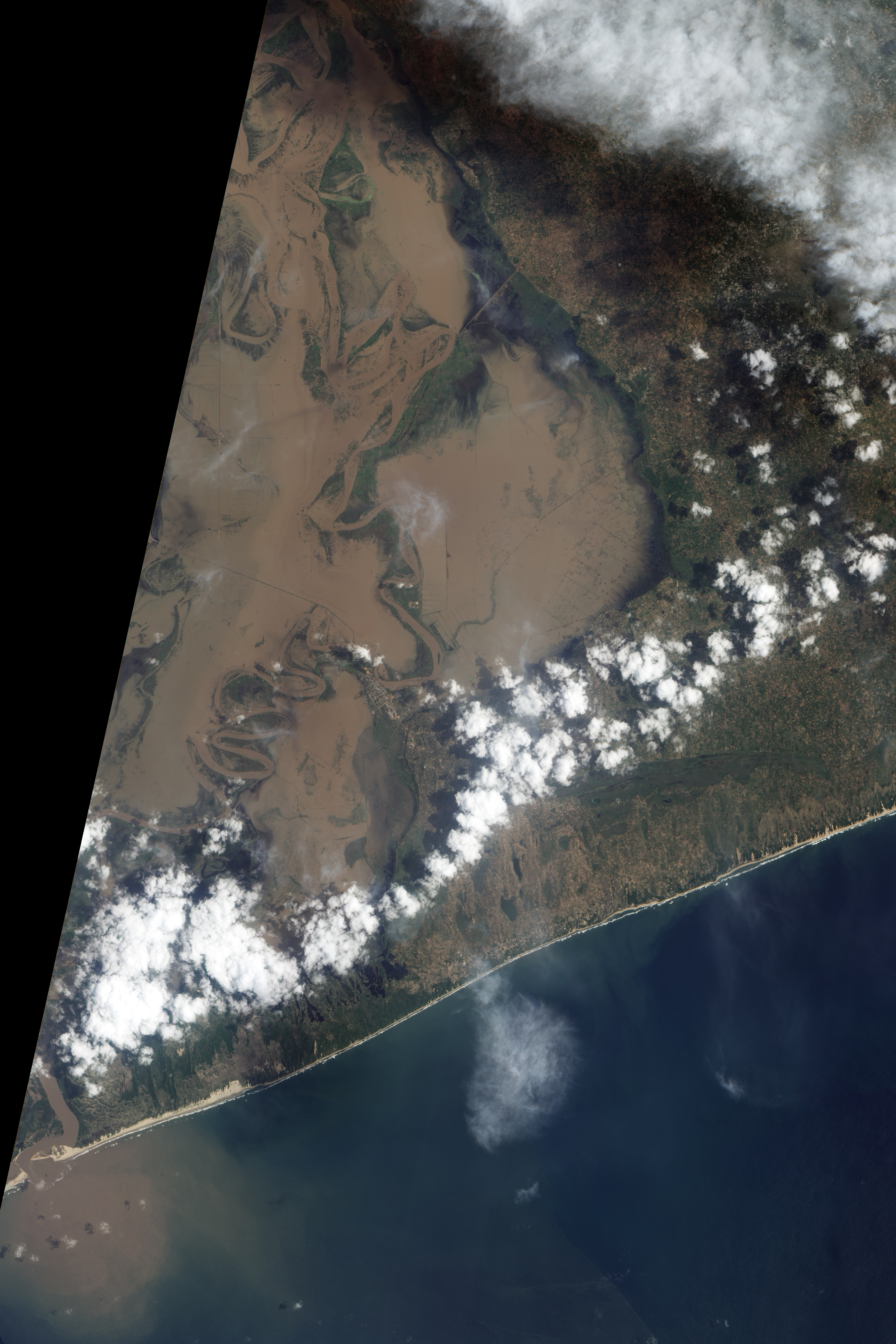
After days of torrential rain pushed the lower Limpopo River over its banks in late January 2013, flood water surrounded the city of Xai-Xai in southern Mozambique. The Advanced Land Imager (ALI) on NASA’s Earth Observing-1 (EO-1) satellite captured this natural-color image on January 31.
Xai-Xai is situated about 10 kilometers (6 miles) from the ocean, where the Limpopo River meanders over a flat coastal plain. In late January, muddy water not only filled the river channel, but also washed over agricultural fields. Muddy water could even been seen in the rectangular street grid of Xai-Xai.
The United Nations Institute for Training and Research (UNITAR) anticipated the flooding. On January 29, the institute reported that flood water had reached the northern edges of Xai-Xai; that the airport was inundated; and long stretches of roads had been flooded. UNITAR reported that the high water on the Limpopo—which had already inundated Chókwé—would continue to drain southward.
Flood waters were not confined to the lower Limpopo River. According to Voice of America and other news sources, flooding also struck the Zambezi River in northern Mozambique, as well as parts of Zimbabwe, Botswana, and South Africa. On February 2, Agence France-Presse reported that the death toll in Mozambique had reached 68, and the estimated number of people affected ranged from 180,000 to 250,000. News sources compared the current flood levels to those seen in the year 2000, when severe flooding claimed several hundred lives.
-
References
- Powell, A. (2013, February 1) Deadly floods hit Mozambique. Voice of America. Accessed February 4, 2013.
- South African Press Association, Agence France-Presse. (2013, February 2) 68 dead as Mozambique floods spread north. Sunday Times. Accessed February 4, 2013.
- UN Country Team in Mozambique. (2013, February 2) Floods in Mozambique: 1800 people rescued in Zambezia Province. ReliefWeb. Accessed February 4, 2013.
- UNOSAT, International Charter. (2013, January 29) Floods over Xai Xai City, Gaza Province, Mozambique (as of 29 Jan 2013). ReliefWeb. Accessed February 4, 2013.
NASA Earth Observatory image by Jesse Allen and Robert Simmon, using EO-1 ALI data provided courtesy of the NASA EO-1 team. Caption by Michon Scott.
- Instrument:
- EO-1 - ALI - NASA
Monday, 4 February 2013
Floods leave trail of suffering and despair

A Mozambican woman displaced by floods collects food parcels at a feeding station set up by Gift of the Givers and the SA National Defence Force near Chokwe, southern Mozambique Picture: KEVIN SUTHERLAND
With fear etched in her face, Salino Chauke clutches a dirty sheet close to her chest.
Wracked with pain, she sings softly as she rocks back and forth, tears welling in her eyes.
Beneath the soiled red and black sheet is Fetina, her youngest child, a three-month-old boy.
For days, with nothing but a bag of maize meal and several bottles of water, the Mozambican mother and her two sisters have been walking. Their reason for walking nearly 70km was to seekshelter, food and medical help from the Gift of the Givers aid workers and South African soldiers and medics.
The sisters fled their home in Gaza province when neighbouring villagers ran to alert them of approaching flood waters.
Within minutes their home was swamped. Rapidly rising waters from the swollen Limpopo River forced them to make drastic and potentially deadly choices: stay and drown or flee while you still can. They and thousands of others chose the latter.
For days, families of about 20 000 people who were left behind gather at the Chokwe displaced people's camp waiting for news of their loved ones.
Those left behind were either too old or too frail to flee.
With their youngest children clutched to their chests, the sisters ran, abandoning their seven older children and a wheelchair-bound uncle.
"You can help me, you can find them," says Chauke, her eyes seeking confirmation.
Clutching Fetina close to her chest as he cries, Chauke rocks back and forth, singing lullabies.
Fetina has not been fed for days. Chauke's breast milk has dried up because of a lack of food.
Her last meal was two days before the floods, which have claimed 80 lives and displaced nearly 200000 . "It's okay," Chauke whispers to Fetina, "It's okay."
The she turns to the South Africans: "Please help us. I tried to phone them, but there is no one. The phones are dead. I just want to know they're alive. That is all. Even if I have lost my house I just want my children to be alright.
"They say South Africans can help. You are South Africans, please help us."
Survivors are desperate for assistance, for news on any survivors. A mother, who escaped with her two children, has resigned herself to her fate.
A neighbour, who escaped the rising waters with her in a small boat, says the woman's husband and two older children drowned while helping her and their younger siblings.
"Her two children are all that she has ... They and the plastic covering them."
For SA National Defence Force dietician Faith Sketana, the plight of the displaced is difficult.
"Where do you start? For every one you help there are hundreds others. Everywhere you look, someone has lost someone, is hungry, needs shelter. It is really difficult.''
"We just have to carry on doing the best we can," Sketana says.
Gift of the Givers founder Dr Imtiaz Sooliman said the need was massive.
"The challenges are tough, but we will do it ... We are helping wherever we can, even to just provide comfort."
After being given a packet of rice, Chauke asks for one thing: "Please do not forget.
''Do not forget us when you go home. We will never forget what you have done for us - what South Africa did for Chokwe."
- Times Live
Plan to steal aid from flood victims

The South African Airforce is helping thousands of Mozambicans who have been displaced by floods which ravaged the country. At least 70 people were killed in the floods and 150 000 were left homeless. The Gift of the Givers has sent a team to deliver goods to help with the rescue efforts. Picture: DANIEL BORN. 30/01/2013. © THE TIMES Image by: DANIEL BORN
The uncovering of a scheme to steal millions of rands worth of humanitarian aid intended for 60000 Mozambique flood survivors has forced South African aid agency Gift of the Givers to withdraw from the country's biggest displaced people's camp.
Hours before nearly R2-million worth of aid was to be distributed yesterday in the camp outside Chokwe - near the centre of the area in which floods 10 days ago killed 80 people and displaced nearly 200000 - the organisation discovered that the camp's administrators had created fake lists of beneficiaries.
The needy victims of the floods, especially the thousands of women and children living in the camp, were the intended recipients of the aid.
The order for the withdrawal of the Gift of the Givers team was given when the charity's founder, Imtiaz Sooliman, discovered that at the top of the list of aid recipients were the camp's administrators and their families.
"Things went wrong because of the Mozambican government officials. I issued instructions for lists containing the names of women and children, and of the elderly and sick, to be given to me today. Instead we discovered these bogus and fictitious lists with the names of people not in need of anything.
"They were taking from the people we were meant to be helping."
Sooliman said Gift of the Givers had immediately withdrawn their aid and set up links with church groups operating in the village of Hokwe.
More than 3500 families - many of them with severely ill infants - who lived in Chokwe fled to Hokwe when the floods struck.
Within moments of the food trucks and ambulances, along with South African soldiers, arriving in Hokwe people ran to the village centre to beg for assistance.
Church elder Domingos Utui said the situation was desperate.
"We have many families camping in empty schools and buildings. They fled here because they had nowhere to go.
"The government has been slow to provide assistance and the people had no choice but to come to us.
"We have nothing to help them with ... our villages have run out of food. Your presence here is an answer to our prayers. Without South Africa's help many would have died," said Utui.
Sooliman said his organisation would stay in Hokwe for as long as needed.
"We are giving food straight to the people ... it is not going to any administrators or government officials. We are distributing special baby food, porridge, beans, rice, maize meal and water, along with clothing and sanitary wear."
- Times Live
Sunday, 3 February 2013
"We have much to do," says UN Humanitarian Coordinator in Chokwe
Maputo, 31 January 2013 - “Basic needs are being met, such as food, water, and shelter, despite very difficult conditions in many areas of the flooding,” says United Nations Humanitarian Coordinator Jennifer Topping at the end of her visit on Wednesday to Chiaquelane camp, where about 70,000 have sought refuge from the flooding of the Limpopo River.
Ms. Topping travelled to the camp together with UNICEF National Goodwill Ambassador Stewart Sukuma and the representative for UNICEF Mozambique Jesper Morch, who also was optimistic about the response.
“Contingency plans by the UN and by the Government of Mozambique are working well, we are up to speed and working in a timely manner,” said Mr. Morch.
They both agreed however that much more needed to be done to make sure adequate help was reaching those who needed it the most.
“We still have areas that are inaccessible,” said Ms. Topping. “Not everyone is receiving help and demands are very high. There is much work ahead for all of us.”
To date, about 150,000 people have been displaced by the flooding of the Limpopo River in Gaza Province, and are now living in temporary settlements in the area, including in Chiaquelane, which has the largest number of displaced.
A drive through Chokwe, hit hard by the flooding, revealed a near-deserted city, but for a few residents who either never left or are back to begin the long, arduous job of cleaning up their homes and neighbourhoods.
But receding waters in the city are leaving mud, dirt, and animal cadavers behind, with the risk of disease becoming a major concern.
“Together with government we are treating this as a top priority but we are under-resourced,” said Ms. Topping. “Our aid supplies in-country are becoming depleted and we will need additional funds to make sure we have what we need to help people recover from this terrible tragedy,” she said.
This week, the UN Humanitarian Country Team in Mozambique has requested the release of emergency UN funds totalling about $5 million to cover the costs of the initial phase of the humanitarian effort. More funds will be requested from the wider donor community early next week.
Patricia Nakell Communication Specialist UNICEF Mozambique
- ReliefWeb
UNICEF scales up support to Malawi’s Flood Victims as rains persist
Floods displace over 33 000 people and destroy schools
LILONGWE, 01 February 2013- UNICEF is scaling up its emergency assistance in Malawi after flooding has hit the country’s southern region. A recent inter-agency assessment estimated that over 33,000 people have been displaced leaving many people without shelter or clothing. Crops have been destroyed in Mangochi, Phalombe and Nsanje districts, while over 20 schools have been disrupted, affecting thousands of children.
“Communities, government, NGOs and the UN are working together to avert a humanitarian disaster,” said Mr. Mahimbo Mdoe, UNICEF Country Representative in Malawi. “But the rains are persistent and we remain on high alert as the flooding spreads to other areas.”
The persistent rains have destroyed roads making access to flooded areas difficult for the delivery of relief materials. Food, emergency shelter, medical supplies and other non-food household items such as blankets, buckets and pots are urgently needed for the affected amilies. The flooding has also compromised access to safe water, sanitation and overall hygiene in the affected communities.
In response, UNICEF is providing communities with a combination of water, sanitation and hygiene-related supplies. Supplies include chlorine, soap, water purification chemicals, plastic sheeting for construction of temporary bathing and latrine shelters, as well as hygiene awareness campaigns to prevent the risk of cholera.
Many displaced families have sought shelter in schools using them as kitchens and bedrooms resulting in considerable damage to school furniture and disruption in learning in at least 20 locations. UNICEF has provided the school-in-a-box supplies to ensure that quality learning resumes in the affected primary schools.
“Vital supplies are getting through to stricken communities,” said Mr. Mdoe. “But as UNICEF we remain vigilant, monitoring childhood diseases, ensuring schools are functional and that children go back to learning.”
Despite the flooding, Mangochi, Phalombe, and Nsanje are also among the districts hit hardest by the current drought, which has left nearly 2 million people food insecure and children at a high risk of malnutrition and disease across the country.
- ReliefWeb
Floods in Mozambique: 1800 people rescued in Zambezia Province
Maputo, February 2, 2013 - As Mozambique is fustigated by heavy flooding, 1 800 people were rescued in the last two days in Nicoadala district of Mozambique´s central Zambezia Province resulting from a weeklong heavy rains in the country and the region.
The rescue operation is being led by the National Institute of Disaster Management with the support of the National Civil Protection Unit (UNAPROC), mobilized for the purpose, provided that the situation has reached the level of a catastrophe.
The National Center for Disaster Management regional director Belém Monteiro, told reporters on February 1, that there are several cases of people in very desperate situation requiring rapid rescue by authorities. Only yesterday, according to our interviewee, over 800 people were saved and search and rescue operations continue.
Other reports indicate that floods have affected over 37000 students as a result of flooding or destruction of 625 schools across Zambezia alone.
The spokesman for the provincial department of Education and Culture in Zambezia, Armindo First, said, however, in many cases classes resumed thanks to the collaboration of religious organizations that provided their properties. "Primary education is being severely affected by the disaster situation," said Armindo first, added that some communities where the waters started to recede are rebuilding educational institutions.
Authorities report that the floods have already claimed nine lives in the province.
- ReliefWeb
Mozambique: Floods - Preliminary Emergency appeal n° MDRMZ010


This Preliminary Emergency Appeal seeks CHF 662,337 in cash, kind, or services to support the Mozambique Red Cross Society (CVM) to assist 15,000 beneficiaries for 6 months, and will be completed by the 1 August, 2013. A Final Report will be made available by 1 November 2013 (three months after the end of the operation).
CHF 300,000 was allocated from the International Federation of Red Cross and Red Crescent (IFRC) Disaster Relief Emergency Fund (DREF) to support this operation. Unearmarked funds to replenish DREF are encouraged.
Summary: Since early January 2013, heavy rains are continuing in southern and central Mozambique and throughout Southern Africa region. These torrential rains have caused destruction of houses, schools, health centres and crops, forcing the affected populations to leave their homes in search of safer areas, mainly in Maputo City, Gaza and Inhambane Provinces. To date, some 143,408 people (28,701 households) have been affected.
Based on the situation, this Preliminary Emergency Appeal responds to a request from the Mozambique National Society, and focuses on providing support to take an appropriate and timely response in delivering assistance and relief in the following sectors: relief, emergency shelter, emergency health, water, and sanitation and hygiene promotion.
The IFRC has sent a Field Assessment and Coordination Team (FACT) to support the National Society with initial assessments, coordination and planning / implementation of the initial response. The FACT will work with the CVM to decide on other support required.
Full report and appeal available HERE.
- ReliefWeb
Flooding along the Fitzroy River


In eastern Queensland, the Mackenzie-Fitzroy River system takes a circuitous route to the coast, finally emptying into the sea near Rockhampton. In late January 2013, flood waters swelled these rivers and their tributaries so much that satellite sensors could easily detect the changes from the sky. The flooding resulted from heavy rains caused by the ex-tropical Cyclone Oswald.

The Moderate Resolution Imaging Spectroradiometer (MODIS) on NASA’s Terra satellite captured the top image on January 30, 2013. For comparison, the bottom image shows relatively normal conditions observed on January 17, 2013. These images use a combination of visible and infrared light to better distinguish between water and land. Water varies in color from electric blue to navy. Vegetation is bright green and bare ground is earth-toned. Clouds are pale blue-green and cast shadows onto the land surface below.
In the image from January 17, upstream of the city of Rockhampton, the rivers are barely discernible. In the image from January 30, higher water levels color the river channels varying shades of blue, and water has spilled onto floodplains at multiple locations along the river system.
On January 31, 2013, the Australian Associated Press (AAP) described the Fitzroy River as “swollen and crocodile infested,” and multiple news sources reported that the flood surge was expected to reach Rockhampton around February 1 or 2, although the January 2013 flooding was not expected to be as severe as the floods that struck in 2011. On January 30, the AAP reported that the death toll from the latest round of floods had risen to six.
The January 30 image above shows not only higher water levels but also more extensive greenness compared to January 17. The greater degree of green may result from a difference in the angle of the satellite sensor, but may also reflect a green-up from new precipitation. Before Oswald brought heavy rains and floods to the region, large stretches of eastern Australia were suffering from rainfall deficiencies.
References
- Australian Government Bureau of Meteorology. (2013, January 4) Rainfall deficiencies expand in eastern Australia. Accessed January 31, 2013.
- Johnson, S., AAP. (2013, January 31) “Business as usual” despite rise in river. News.com.au. Accessed January 31, 2013.
- The Morning Bulletin. (2013, January 31) 1100 properties to be affected when Fitzroy River peaks. Accessed January 31, 2013.
- Robinson, P. (2013, January 30) Fitzroy River continues rising amid “sea of water.” ABC Australia. Accessed January 31, 2013.
NASA images courtesy LANCE MODIS Rapid Response. Caption by Michon Scott.
- Instrument:
- Terra - MODIS - NASA
Friday, 1 February 2013
Flooding in Mozambique


In a little over two weeks, heavy rains transformed the landscape of southern Mozambique. On January 9, 2013, the lower Limpopo River was barely discernible from the sky. By January 25, the river had spilled over its banks, with water spreading more than 10 kilometers (6 miles) across the landscape in places.
The Moderate Resolution Imaging Spectroradiometer (MODIS) on NASA’s Terra satellite captured these images on January 25, 2013 (top), and January 9, 2013 (bottom). Both images use a combination of visible and infrared light to better distinguish between water and land. Water ranges in color from navy blue to teal. Vegetation is bright green. Clouds are pale blue-green and cast shadows.
On January 25, the BBC reported that roughly 85,000 people had been affected by flooding, about 65,000 of them in the southern Mozambique province of Gaza. The city of Chókwé was among the worst-hit, and the United Nations warned that the number of people affected could reach 100,000 if flooding worsened in the coastal city of Xai-Xai. On January 27, Al Jazeera reported a higher number of residents displaced by the flooding: nearly 300,000. A reporter from Agence France-Presse reported seeing tens of thousands of Mozambique residents camped along roadsides.
Flooding was not confined to Mozambique. It also affected Zimbabwe, Botswana, and South Africa. In South Africa, flooding had forced the operators of a crocodile farm to open the gates, releasing approximately 15,000 crocodiles, the BBC said.
-
References
- BBC. (2013, January 25) UN: Floods displace 70,000 and kill 36 in Mozambique. Accessed January 28, 2013.
- Mutasa, H. (2013, January 27) “Dire situation” after Mozambique floods. Al Jazeera English. Accessed January 28, 2013.
NASA images courtesy LANCE MODIS Rapid Response. Caption by Michon Scott.
- Instrument:
- Terra - MODIS - NASA
Thursday, 31 January 2013
SANDF helping Mozambique back onto its feet after floods
The humanitarian side of the South African National Defence Force (SANDF) is again proving its worth in flood-stricken Mozambique where a number of military elements have been working 24/7, helping thousands displaced by floodwaters.
Additionally, the South African Air Force (SAAF) is providing airlift capability to Gift of the Givers. 28 Squadron C-130 transport aircraft have started moving more than 150 tons of food, donated by supporters of the Pietermaritzburg headquartered non-government organisation, to areas most in need.
The SANDF deployment includes Navy divers, SAAF Oryx helicopters and crew as well as primary health care nurses, dieticians and environmental health officers from the SA Military Health Service.
SANDF personnel have been in Mozambique for just over a week, first assisting in moving flood victims to safety while Navy divers did search and rescue tasks in swollen rivers.
“The joint operation has made it possible for the SANDF rescue team to distribute food as flood levels have been receding and search and rescue operations are now making way for food distribution actions,” SANDF Corporate Communications Director Brigadier General Xolani Mabanga said.
“The SANDF is still on standby in flood stricken areas with helicopters, medical personnel and search and rescue teams.”
Speaking to the Afrikaans daily Beeld, Colonel Andre Pieterse said from the hastily erected aid centre in the country, SANDF personnel had rescued at least 500 people from the raging Limpopo River in Mozambique earlier this week. This included hoisting people to safety from rooftops and out of trees.
Medicins Sans Frontieres/Doctors with Borders (MSF) is also been active in flood-ravaged areas of Mozambique as well as Malawi and Zimbabwe.
Just how badly South Africa’s eastern neighbour was hit by the heavy rain and subsequent flooding is starkly illustrated by Lucas Molfino, MSF medical co-ordinator in Mozambique.
He said: “Chokwe gives the impression of being a post-war scene. The majority of the population have been evacuated to temporary shelters. In the centre of town there are obvious issues related to sanitation and public health because of dirty stagnant water and the presence of dead animals on the streets.”
MSF estimates are there are around 114 000 people currently staying in 10 transitional camps. Sanitation is a major concern at the largest camp, Chiaquelane, close to Chokwe. There are currently 60 latrines to serve a displaced population of about 50 000 Molfino said.
The two health facilities in the area are out of drugs and malaria rapid tests and attend to about 300 patients a day. There is no ambulance for referrals and the main hospital lacks staff and equipment he added.
The SANDF contingent deployed to Mozambique last week in order to provide humanitarian assistance in the flood stricken areas. The contingent included South African Navy Divers, health professionals from the South African Military Health Services, two Oryx helicopters and a C-130 Hercules aircraft from the South African Air Force. The Maritime Reaction Squadron from the South African Navy is on standby.
- Defence Web
Additionally, the South African Air Force (SAAF) is providing airlift capability to Gift of the Givers. 28 Squadron C-130 transport aircraft have started moving more than 150 tons of food, donated by supporters of the Pietermaritzburg headquartered non-government organisation, to areas most in need.
The SANDF deployment includes Navy divers, SAAF Oryx helicopters and crew as well as primary health care nurses, dieticians and environmental health officers from the SA Military Health Service.
SANDF personnel have been in Mozambique for just over a week, first assisting in moving flood victims to safety while Navy divers did search and rescue tasks in swollen rivers.
“The joint operation has made it possible for the SANDF rescue team to distribute food as flood levels have been receding and search and rescue operations are now making way for food distribution actions,” SANDF Corporate Communications Director Brigadier General Xolani Mabanga said.
“The SANDF is still on standby in flood stricken areas with helicopters, medical personnel and search and rescue teams.”
Speaking to the Afrikaans daily Beeld, Colonel Andre Pieterse said from the hastily erected aid centre in the country, SANDF personnel had rescued at least 500 people from the raging Limpopo River in Mozambique earlier this week. This included hoisting people to safety from rooftops and out of trees.
Medicins Sans Frontieres/Doctors with Borders (MSF) is also been active in flood-ravaged areas of Mozambique as well as Malawi and Zimbabwe.
Just how badly South Africa’s eastern neighbour was hit by the heavy rain and subsequent flooding is starkly illustrated by Lucas Molfino, MSF medical co-ordinator in Mozambique.
He said: “Chokwe gives the impression of being a post-war scene. The majority of the population have been evacuated to temporary shelters. In the centre of town there are obvious issues related to sanitation and public health because of dirty stagnant water and the presence of dead animals on the streets.”
MSF estimates are there are around 114 000 people currently staying in 10 transitional camps. Sanitation is a major concern at the largest camp, Chiaquelane, close to Chokwe. There are currently 60 latrines to serve a displaced population of about 50 000 Molfino said.
The two health facilities in the area are out of drugs and malaria rapid tests and attend to about 300 patients a day. There is no ambulance for referrals and the main hospital lacks staff and equipment he added.
The SANDF contingent deployed to Mozambique last week in order to provide humanitarian assistance in the flood stricken areas. The contingent included South African Navy Divers, health professionals from the South African Military Health Services, two Oryx helicopters and a C-130 Hercules aircraft from the South African Air Force. The Maritime Reaction Squadron from the South African Navy is on standby.
- Defence Web
SANW doen noodleniging in vloedgeteisterde Mosambiek
Die Suid-Afrikaanse lugmag en vloot het reeds meer as 490 mense gered wat deur vloedwater in Mosambiek vasgekeer was. Die weermag is ook in die land ontplooi om noodlenigingswerk te doen na oorstromings groot verwoesting gesaai het.
- E-NUUS
Subscribe to:
Posts (Atom)